


This special edition of our Cultures of Wellbeing blog series was co-written by Mandy Luu! Mandy joined the Do Good Leadership Collective team in July 2026 for a summer internship through the Youth Mental Health Academy. Through her academic and community service experiences, she developed an interest in mental health advocacy, and hopes to explore how community-based efforts can contribute to better healthcare and wellbeing.
“If everything feels urgent, nothing really is.”
“If you have more than three priorities, you don’t have any.”
These are quotes we tend to share with nonprofit organizations that are up to their eyeballs in workloads. As a nonprofit leader, we know your dedication to fulfilling your organization’s mission and making an impact are crucial driving factors in your work. But when competing priorities stack up, everything can begin to feel urgent, leading to increased stress and burnout among your staff. Learning to prioritize what matters most to your mission can help to build a healthy nonprofit workplace culture.
What Is Workplace Wellbeing Strategy?
Workplace wellbeing strategy looks at the organizational conditions that shape how people experience work, and creates custom solutions that support overwhelmed nonprofit leaders. For nonprofit and social impact organizations, this means moving beyond individual self-care and addressing the systems, practices, and culture that can help to improve workplace culture.
For nonprofit organizations looking to reduce staff turnover, prevent burnout, and build healthier and more sustainable teams, investing in workplace wellbeing strategy is a critical focus--especially during times of upheaval and uncertainty. Workplace wellbeing strategy does not come with a one-size-fits-all approach. When done well, these co-created initiatives support new ways of working together that are responsive to people’s needs and the organization's mission and values.
How Can Prioritizing What Matters Most To Support Staff Wellbeing?
Competing priorities arise when multiple goals demand attention at the same time, making it difficult for leaders to determine what needs immediate focus. For nonprofits, especially those that provide community services, competing priorities are especially common. This is due to the nature of many nonprofit models: raise dollars to support communities → spend those dollars in ways that lead to real impact → report on the impact to prove effectiveness and secure more funding.
This sequence alone is often the main priority of any nonprofit organization. However, what this sequence doesn’t highlight are the many other factors that are needed for running a nonprofit business, including managing personnel, evaluating programs, board governance, marketing, operations, budgeting, and more.
Although every responsibility within a nonprofit serves an important purpose, treating everything as a priority can stretch staff capacity beyond what is sustainable--particularly in underfunded organizations. When employees are continually expected to take on responsibilities outside of their roles in the name of “doing more with less” or “wearing many hats,” we run the risk of eroding their sense of accomplishment, diminishing their ability to do meaningful work well, compromising their motivation, and ultimately undermining their overall wellbeing.
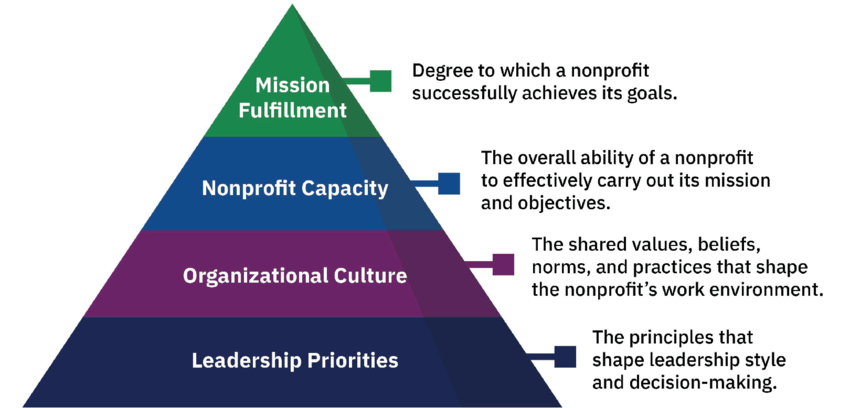
Bridging the gap between management priorities and mission fulfillment. Credits: UF/IFAS
There are many different models for learning how to prioritize what matters. We are inspired by this model that bridges the gap between leadership priorities and mission fulfillment. Often, organizational priorities are led by an organization's mission, which dictates how successful an organization is year over year. A mission informs the organizational strategy, and leadership is responsible for carrying out the strategy.
However, this model reminds us that organizations are more than missions and leadership. All organizations must keep in mind culture and capacity. As a leader, what you value, emphasize, and prioritize has a major impact on the culture and capacity of those who follow.
Prioritizing what matters most as a leader, particularly for the sake of reducing burnout, doesn't mean that certain responsibilities are unimportant. It means recognizing that you have the influence to determine how time, attention, money, and resources are allocated—and the responsibility to be intentional about where they are needed most.
Managing priorities for your team is about using resources effectively, not just efficiently. It requires flexibility and clarity as conditions change, while keeping the sustainability of your people at the forefront. Rather than constantly asking how to get more done with less, effective prioritization invites us to ask important questions about what truly needs to get done, what matters most, and how can these things get accomplished with sustainability in mind.
2 Questions to Consider
1. How are our leadership priorities translated into the everyday experience of the organization?
Consider whether your stated priorities align with employees' day-to-day experiences, or whether there is a disconnect between what leadership values and what staff are actually experiencing.
2. Does my team currently have the ability, resources, or infrastructure to execute this strategy/mission?
Having a clear strategy is only one part of the equation; your team also needs the capacity to bring it to life. Consider whether staff have the time, tools, support, and resources to meet current expectations without compromising the quality of their work or their wellbeing.
2 Action Steps to Get Started
You don't have to address every competing priority at once. Start by creating clarity around what matters most to the organization right now and making intentional decisions about how your organization allocates its resources.
1. Revisit Your Strategy More Frequently to Define Priorities: Oftentimes, organizations set priorities based on strategies that were established in previous years. We’re taking inspiration from the 12-Week Year strategy, and encouraging leaders to break larger strategic goals into shorter planning cycles. This creates opportunities to identify which goals require the most attention right now, adjust as conditions change, and remain responsive to emerging organizational needs.
2. Reassess Your Strategy Against Your Team's Capacity: Building on the first action step, be sure to regularly review your team's current responsibilities, deadlines, and workload. Identify tasks that can be delayed, delegated, simplified, or removed. Importantly, always make space for staff to communicate when expectations exceed their capacity.
Prioritization should be an ongoing conversation and not a one-time decision. Regular check-ins can help leaders stay responsive to organizational needs while ensuring staff aren't continually expected to do everything at once.
Join the Conversation!
At Do Good Leadership Collective, we believe nonprofit employees shouldn't just survive their work—they should thrive in it. Check out our services page to learn how we can help you step back and prioritize what matters most. If this post resonated with you, share it with your network or continue the conversation!
Resources
This blog was edited by Florine Causer, our Strategic Communications & Wellbeing Consultant.